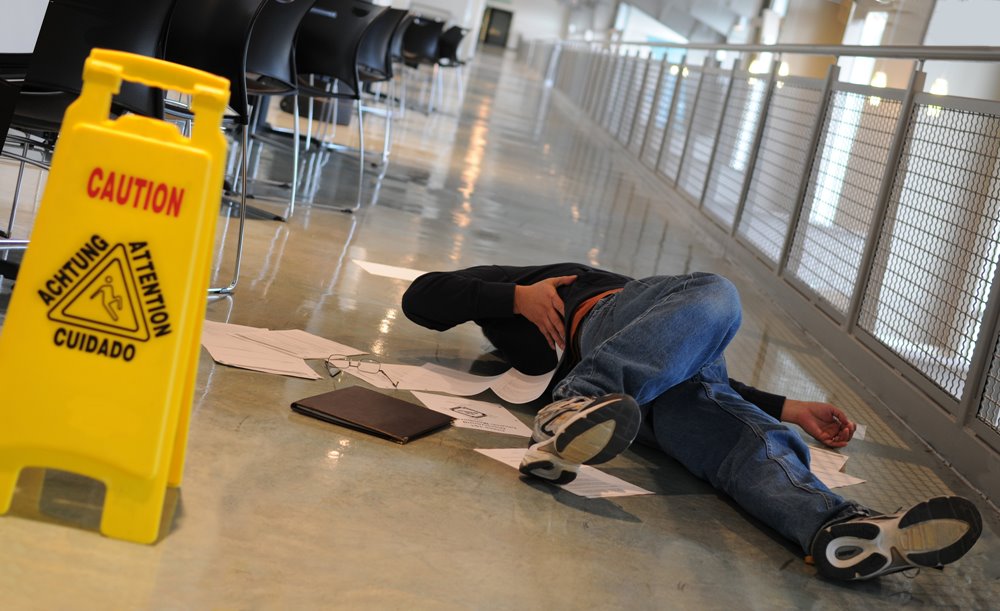
Slip and fall injuries happen in an instant, but the legal claim that follows is rarely simple. In Tennessee, an injured person generally must show that the property owner either created the dangerous condition or knew, or should have known, about it in time to fix it or warn visitors. Notice is not a form you file; it is one way of proving the claim.
This guide explains how that proof works, what evidence supports it, how claims against government-owned property differ, and why acting quickly matters under Tennessee's one-year filing deadline.
People often assume that falling on someone's property establishes the claim by itself. It does not, and the gap between those two positions is where insurers concentrate their defense.
Under Blair v. West Town Mall, 130 S.W.3d 761 (Tenn. 2004), an injured person generally must prove one of two things. The first is that the owner or its employees caused the dangerous condition. In that case, notice is not required, because the owner cannot claim ignorance of a hazard it created. The second is that the owner had actual notice, meaning it knew about the condition, or constructive notice, meaning the condition existed long enough or arose in a pattern that made it foreseeable that the owner reasonably should have known.
That is why the timing of the hazard matters so much. A spill two minutes old and a spill two hours old produce very different cases from an identical fall.
Actual notice is the simpler of the two to describe and the harder to find. It exists where someone reported the problem, where staff observed it, or where the owner created the condition themselves.
Constructive notice is usually built from circumstances rather than from a single document. The material that tends to establish it includes:
Recurrence is often the strongest of these. A leak that returns whenever it rains is a different proposition from a single unforeseeable spill.
Claims against the government are different from claims against private property owners, and missing that difference can sink a case.
In Tennessee, local governments are generally protected from lawsuits unless a state law, the Governmental Tort Liability Act, says otherwise. For falls, the two main exceptions cover unsafe streets and sidewalks (Tenn. Code Ann. § 29-20-203) and dangerous conditions in public buildings (§ 29-20-204). In both cases, you have to show the government knew about the problem or should have known because it had been there long enough to be noticed. Unlike a private owner, a government usually can't be held responsible just because its own employees created the hazard, unless a different exception applies.
Showing the government knew about the hazard is part of proving your case. It is not a form you file or a deadline you have to meet, and mixing those up can cause a strong claim to fail. If the property belongs to the State itself rather than a city or county, the claim goes through a separate body called the Tennessee Claims Commission, which has its own rules, so it's important to find out who owns the property first.
A few other differences apply. A judge decides the case, not a jury. The amount you can recover is limited by law, currently $300,000 per person and $700,000 per incident for bodily injury (§ 29-20-403). And you have only twelve months from the date of the injury to file a lawsuit (§ 29-20-305(b)).
Tennessee applies modified comparative fault to premises claims, and an insurer will look for a percentage to attach to the injured person. The usual argument is that the hazard was open and obvious, or that footwear, distraction, or a phone contributed.
Under Tennessee's rule, an injured person recovers only if their own share of fault is less than fifty percent, so this is not a peripheral argument. Below that line, the recovery is reduced proportionally.
The open-and-obvious argument works differently than many people expect. Under Coln v. City of Savannah, 966 S.W.2d 34 (Tenn. 1998), an obvious hazard does not automatically end the case. Courts weigh it as part of comparative fault, and a duty can still exist where the foreseeability and gravity of the harm outweigh the burden of protecting against it, for example, where an owner should have expected people to be distracted or to have no practical alternative route.
An adjuster's percentage is a negotiating position rather than a finding. Fault is allocated by the trier of fact, not by the person handling the file.
The retail volume around Hamilton Place and the SR-153 corridor produces a steady stream of these incidents in car parks, entrances, and the transition points between outside and inside where surfaces change.
Brainerd Road adds dense commercial frontage of a different character, with older buildings and varied surface conditions. Downtown and the Southside bring tourism traffic through venues and pavements that were not designed for the footfall they now carry.
Each setting produces its own evidence. A national retailer usually has inspection logs and camera coverage, while a small independent premises may have neither, which changes how constructive notice has to be established.
Someone handling a Chattanooga slip and fall claim may therefore need to focus closely on records showing when the hazard appeared and whether anyone knew about it.
| Privately owned premises | Government-owned walkway or structure | |
| Notice requirement | Actual or constructive notice of the condition | Actual or constructive notice, Tenn. Code Ann. 29-20-203 and 29-20-204 |
| Jury | Available | No jury, Tenn. Code Ann. 29-20-307 |
| Recovery | Subject to comparative fault | Subject to comparative fault and the statutory caps |
What Notice Must a Tennessee Slip and Fall Claim Establish?
The claim generally depends on showing the owner or occupier had actual notice of the dangerous condition or constructive notice, meaning they reasonably should have known of it.
Is it notice something I file or something I prove?
On a private premises claim, it is something you prove. Where the property belongs to a governmental entity, Tenn. Code Ann. 29-20-203 and 29-20-204 make notice of the defect a substantive element of the claim.
Does it matter that the hazard was obvious?
It can. Tennessee applies comparative fault, and an injured person recovers only if their own share of fault is less than fifty percent.
Does It Matter How Long the Hazard Was Present?
Yes. Duration is often the central fact in establishing constructive notice, because it goes to whether the owner reasonably should have discovered it.
Two falls that look similar can be governed by different rules depending on who owned or controlled the property. Establishing that ownership early can help determine which legal requirements apply.
Fox & Farmer offers a free consultation. You can reach the firm at (423) 531-9400 or through its contact page.
Last reviewed: September 2026
This post was reviewed by Bradley A. Farmer, licensed in Tennessee since 1994.
Content is provided for informational purposes only and does not constitute legal advice. Consult a licensed Tennessee attorney for guidance specific to your situation.

Tennessee applies strict liability when a dog injures someone in a public space or while...

The Tennessee wrongful death statute of limitations is one year, and the detail that catches...
A pedestrian accident on Cumberland Avenue in Knoxville may involve more than one at-fault party....