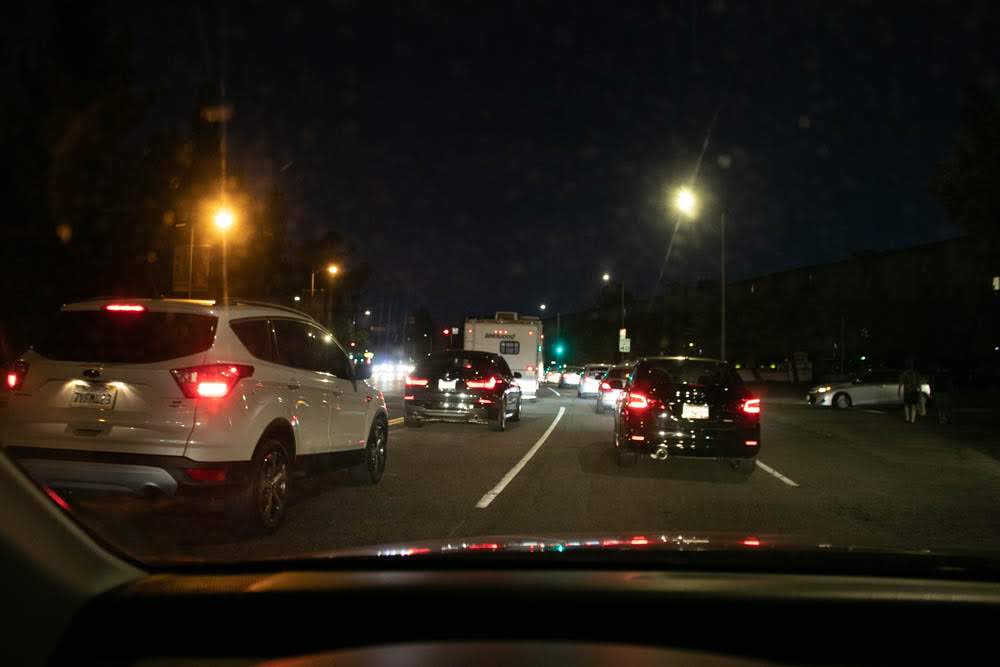
A Tennessee-Kentucky state-line accident on I-75 raises a question that can shape the entire claim: which state's law applies? The answer can affect your deadline, how fault is weighed, and what insurance benefits are available.
Along this stretch of interstate, the border sits close to the local roads and communities that drivers use every day.
Campbell County ends at the Kentucky border, and I-75 crosses it near Jellico at the northern end of the county. From Caryville, the line is roughly 25 miles up the interstate, and from LaFollette it is farther still. It is close enough to matter, but a crash "near the border" is not automatically a border crash.
The corridor itself is demanding. I-75 climbs and descends Jellico Mountain on sustained grades, with runaway truck exposure and winter weather at elevation, and heavy freight moving through on a national route.
A crash that begins on one side of the line can finish on the other. On a mountain grade, vehicles do not always stop where the collision started.
Drivers may assume their state’s laws follow them across the border, but that is not necessarily the case. Choice of law is a separate question that can depend on where the collision occurred, rather than where the driver lives or where the vehicle is registered.
For someone pursuing a personal injury claim in LaFollette, TN, determining which state’s law applies can be an important early step. The answer may affect the filing deadline, fault rules, and where the claim can be pursued.
This article does not attempt to state Kentucky law, and the issue should not be assumed based solely on proximity to the border. What can be stated is the Tennessee position: most injury claims generally carry a one-year deadline from accrual under Tenn. Code Ann. § 28-3-104(a)(1), leaving limited time to resolve which rules govern.
In most collisions, nobody records the precise location beyond naming the nearest exit. Where a state boundary is close, that detail stops being incidental.
Worth fixing while it is still available:
Reconstructing this months later is difficult and sometimes impossible. A driver who recalls only that the crash happened somewhere north of Caryville has left the threshold question to be argued about.
Investigation follows jurisdiction. A crash on the Tennessee side may be worked by the Tennessee Highway Patrol, which handles interstates and state routes, or by local police depending on the location. Across the line, it is another state's agencies entirely.
That has practical consequences for obtaining records. Different request procedures, different timescales, and different report formats mean that asking the wrong agency costs weeks a one-year period cannot spare.
Medical care can also split across states. The nearest Level I trauma center for serious injuries is the University of Tennessee Medical Center in Knoxville, roughly 40 miles from LaFollette and considerably farther from the state line. On a mountain corridor in winter, that is a substantial journey. A Kentucky-side crash may send patients to Kentucky facilities, so medical records may sit in more than one state.
The freight volume on this corridor means many of these crashes involve a carrier rather than a private motorist. A tractor unit crossing the line may be operated by a business based in neither state, insured somewhere else again, and hauling for a shipper in a fourth.
Federal motor carrier regulations require carriers to generate and keep certain records, such as driver logs and inspection and maintenance files. These do not vary with local reporting practice, but retention periods can be short. Hours-of-service records, for example, generally must be kept only about six months under 49 C.F.R. Part 395, and electronic or telematics data (including engine and dash camera data) may be overwritten sooner. A records request is not guaranteed to succeed after time passes.
For a car accident claim in LaFollette, TN, identifying the responsible parties and preserving relevant records early can become especially important when the crash involves multiple jurisdictions.
Identifying the carrier early matters more here than usual, since a preservation demand has to reach the right business before retention periods run.
If the crash falls on the Tennessee side, a Campbell County claim goes to the Circuit Court for Campbell County in the Eighth Judicial District. The detail worth knowing is that the county seat is Jacksboro rather than LaFollette, though the two towns adjoin each other.
Federal matters for this county sit in the Eastern District of Tennessee, Northern Division at Knoxville. Neither venue is where a resident might first assume.
None of that is an obstacle by itself. It becomes one when someone spends part of a one-year period working out where a filing belongs, which is time the period does not have to spare.
| What to establish | Why it matters |
| The mile marker and direction of travel | It is the fact the choice of law question turns on |
| The investigating agency | It determines where the report exists and how to request it |
| Whether a commercial carrier was involved | Federal records may exist regardless of the state boundary |
Does a Tennessee-Kentucky State-Line I-75 Accident Fall Under Tennessee Law?
Not automatically. Which state's law applies is a separate legal question that can turn on where the collision occurred.
How far is the Kentucky line from LaFollette?
It sits at the northern end of Campbell County, crossed by I-75 near Jellico, a short distance up the interstate.
What is the most useful thing to record at the scene?
The nearest mile marker and the agency that responded, because both bear directly on which rules and which records apply.
On a border-area crash, the precise location can help determine which state’s laws apply. A mile marker, direction of travel, and other location details may become important when the claim is evaluated.
Fox & Farmer offers free consultations. To learn more or discuss your situation, visit the firm’s contact page.
Last reviewed: October 2026
This post was reviewed by Steve E. Fox, licensed in Tennessee since 1992.
Content is provided for informational purposes only and does not constitute legal advice. Consult a licensed Tennessee attorney for guidance specific to your situation.

The Tennessee wrongful death statute of limitations is one year, and the detail that catches...

A third-party work-injury claim that Tennessee law permits is often where the real recovery lies,...

Protecting Victims in Knoxville and Surrounding Areas Alcoa Highway is well-known for its aggressive drivers....